
homefleet-callhomefleet-whatsapp

What Is Rahu Kalam? Meaning and Importance in Hindu Astrology
Author Name Chandrashekar sajja
Jun 22, 2026
What Is Rahu Kalam? Meaning and Importance in Hindu Astrology

Rahu Kalam is a common time that many observe within the Hindu traditions and Vedic astrology. Most people within India would avoid engaging in any vital activity or ventures during this specific period. It is generally believed to be an inauspicious time. Although this practice has been carried out for centuries, the importance is still carried onto modern times in determining auspicious timings for ceremonial events, journeys, monetary affairs, and other religious matters.


By grasping the essence of Rahu Kalam, an individual can begin to understand why this specific time block is so integral to the Hindu belief system. The same is also tied into concepts like Shubh Muhurat and Yamagandam, that are often kept in mind when determining a favorable time.


This guide aims to enlighten you on what Rahu Kalam essentially is, why it is important in Vedic astrology, how it's different from Yamagandam, and some frequent myths and beliefs associated with this.

What Is Rahu Kalam?

The period that falls within the day known as Rahu Kalam is thought to be inauspicious time for starting any significant activity, according to Hindu mythology. Initiating any activity within this time frame will cause delays or other hindrances according to Hindu mythology.

Unlike a fixed timing, Rahu Kalam changes everyday depending on the sunrise and sunset.


Rahu Kalam Meaning

The term “Rahu Kalam” is derived from two words of Sanskrit language; Rahu, meaning Rahu who is one of the nine celestial influences or Nava grahas of Hindu Astrology and “Kalam” meaning time/period.

Thus the basic meaning of Rahu Kalam can be considered as the time period ruled by Rahu. In this particular period, no good work such as marriage, business, buying new houses and investing money takes place.While normal work can continue, there is an advice not to start any major projects during this time period.


Origin and Significance in Hindu Traditions

The origins of Rahu Kalam can be traced back to the ancient beliefs of Hinduism and astrology. This idea developed along with the studies of planetary impacts on humans and time division based on heavenly bodies.

In accordance with the description of the Hindu calendar, calculations of time in Hindu traditions are tightly associated with astronomical phenomena and religious rituals. The Hindu calendar has been directing different events during many years, and thus timing was of utmost importance. Thus, Rahu Kalam was born as another time-oriented tradition.


Why It Is Considered Inauspicious

In general, Rahu is connected with illusion, confusion, uncertainty, and unexpected situations. Thus, Rahu Kalam is regarded as an inauspicious time to undertake something which will bring a good effect in the future.

It is often believed that doing anything during such a period can be connected with some problems or troubles. Nevertheless, praying, meditating, and other similar practices are permitted to be done during Rahu Kalam.

Rahu Kalam in Hindu Astrology

It's due to this reason Rahu Kalam is treated very important in Vedic Astrology. Also, Rahu is considered a 'shadow' planet among Navgrahas as compared to other planets which are visible. In the basic structure of Vedic Astrology, it has always been said that Rahu is considered as one of the dominant influential bodies which controls human life and life.


Role of Rahu in Vedic Astrology

In Vedic astrology, Rahu signifies ambitions, lust, worldly possessions, transformation, and an event that comes out of the blue. Although thought to be a bad influencer, Rahu can at some points prove to be highly favorable and bring about popularity and renown. Rahu when aspected in the horoscopes of the person results in some great innovation, invention, fame, or eccentric approach of living, but at the same time when not in balance, it also makes life quite chaotic and unreliable.


Considering the opposing natures of Rahu, it is one such influencer when astrological charts are consulted and good auspicious times are determined to be chosen. Traditional elements like Shaligram stone are not overlooked by homeowners and pious persons.


Astrological Importance of Rahu Kalam

Rahu Kala is significant for timing purposes. No matter how favorable a day may be as per the astrologers, you are strongly advised not to commence with important deeds during the said hours. The type of things astrologers do not suggest commencing are: 

● Marriage ceremonies

● Starting a new business

● Making investments

● Commencing an agreement

● Purchasing property

● Important travel 

● Taking on a commitment.

That said, those things that have already started will not be obstructed.


Cultural and Spiritual Relevance

In India today, Rahu Kalam is woven into the fabric of local traditions and culture. Even communities and families planning auspicious events take it into consideration. 

To a lot of people, timing their affairs according to the day's Rahu Kalam is a sign of honour for tradition and not due to any religious anxiety. Many families even perform various rites, sing devotional hymns, or engage in prayers during their scheduled time on this Rahu Kalam.

Importance of Rahu Kalam in Daily Life

Rahu Kalam’s impact isn’t limited to astronomy; it has also come to govern how many decide to go about scheduling significant events or decisions.

Even today, ancient timing rules and modern living continue to exist together.


Why People Consider Rahu Kalam

Many people mark and monitor Rahu Kalam for the good results from activities undertaken during that period of time, this is also part of cultural thinking and beliefs about living life in harmony with cosmic forces and nature for a blissful and prosperous life. 

Many use Panchang, or read up on Panchangas, or consult astrologers about planning the big date/occasion and many take decisions after looking at Vastu dos and don’ts and importance of Vastu for their home.


Activities Traditionally Avoided

Activities generally prohibited during Rahu Kalam:

● Starting a journey. 

● Purchasing a vehicle. 

● Property registration.

● Opening a business.

● Marriage ceremonies. 

● Signing an agreement/contract. 

● Starting an investment. 

The everyday work or the normal routine continues as usual.Some communities/regions are more rigorous about these customs than others.Some others consider it an optional instruction.


Modern-Day Relevance

Even today in India many people consult the Rahu Kalam before taking up anything important in personal as well as in their professional lives. They are commonly found with the mobile applications, website called panchang or with the digital diaries which display the timings daily. 

Younger generations might take the interpretations of the culture in a different way; still there is quite a good percentage of the population still following not taking any starts in life in the Rahu Kalam. No matter the westernisation or advancement, these traditions exist by the side.

Rahu Kalam and Shubh Muhurat

Rahu Kalam and Shubh Muhurat are related, as each of these methods help in choosing appropriate muhurat or time to perform certain events. Various factors are taken into consideration by people in search of Muhurat or auspicious time.


What Is Shubh Muhurat?

Shubh Muhurat is an astrologically predicted time that suggests prosperity, auspiciousness, accomplishment and auspicious results. It may perhaps be discovered from planetary locations in conjunction with the moon phase, lunar divisions (nakshatras) & time of week. 

The wedding functions, new dwelling launch work, naming, company debut, & some others, could be performed in this shubh time. The reliable Panchanag guides on shubh muhrat for various performances.


Relationship Between Rahu Kalam and Auspicious Timings

Rahu Kalam The presence of Rahu Kalam during a day often dissuades astrologers from fixing the wedding date during the Rahu Kalam on an auspicious day. 

To put it in other words, the day being favorable doesn’t mean that you should proceed for a new beginning at the inappropriate times. Several Panchang and Muhurta specialists consider a new start only after examining the Rahu Kalam of the day, which along with Vastu rules of house directions, determines the Shubh Muhurat for the housewarming and the settling in new abodes.


Major Events and Muhurat Considerations

Major life events commonly planned with Muhurat considerations include:

● Weddings.

● Housewarming ceremonies.

● Property purchases.

● Vehicle purchases.

● Business openings.

● Naming ceremonies.

● Religious functions.

Although these practices are based on tradition and belief, they continue to hold immense cultural significance for millions of people.

Difference Between Rahu Kalam and Yamagandam

Many are of the opinion that Rahu Kalam and Yamagandam are the same due to the notion that both time durations are considered to be unlucky. 

But, both concepts have their specific importance and usages. Knowing the differences would help understand the times specified on Panchang with much more clarity.


Understanding Yamagandam

In similar fashion, Yamagandam is also another inauspicious time recognized in Hindu practices. Like Rahu Kalam, the daily occurrence of Yamagandam is different each day because it is calculated according to sunrise and sunset times.

In conventional interpretation using Panchang, Yagamandam generally is avoided before starting on travels and major projects. Most daily calendars will show Rahu Kalam, Yamagandam, and Gulika Kalam together.


Key Differences

The following points contrast Rahu Kalam and Yamagandam;

● Rahu Kalam is governed by Rahu while Yamagandam has an association with Yama. 

● The actual timing differs from day to day. 

● It is not considered good to undertake new activities at this time. 

● This varies slightly in some regions from travel being specific for Yamagandam and vice versa.

Though they are considered evil hours for commencing any auspicious endeavor, the significance differs Astrology


Significance in Hindu Astrology

In Hindu astrology, these time periods serve as guidelines rather than rigid rules. Their significance lies in helping individuals choose favorable timings according to traditional beliefs.

Astrologers often analyze several factors simultaneously instead of relying solely on Rahu Kalam or Yamagandam.

Common Misconceptions About Rahu Kalam

Despite its popularity, several myths surround Rahu Kalam. Understanding the facts can help people develop a balanced perspective.


Popular Beliefs and Myths

There is another misconception people carry, they usually feel that during Rahu Kalam nothing should be done at all. This is completely false, people can perform their daily activities, work in the office, study or do household chores at this time as before.


Scientific Perspective

Scientifically, no proof is found anywhere to correlate RAHU Kalam with either success or failure. Astronomers are not listing RAHU as a planet, it is only a mathematical point that is associated with eclipses,so RAHU Kalam is basically a faith and culture,not a scientific fact. It should respect the traditions but still a rationalist has his own way of decision making.


Facts to Know

Some important facts about Rahu Kalam include:

● Its timing changes every day.

● It depends on the local sunrise and sunset.

● Routine activities are not restricted.

● Spiritual practices are considered acceptable.

● It holds cultural significance for millions of Hindus.

● Different regions may follow varying customs.

Understanding these facts helps separate myths from traditional practices.

Conclusion

Rahu kalam is another very prominent notion prevalent within Indian tradition and within astrology. Knowing the Rahu Kalam meaning offers us profound wisdom pertaining to the customs traditionally in practice amongst thousands and thousands in India. Rahu Kalam meaning in Indian astrology essentially goes with timing and being cautious, rather than fearing a day.


The connection of Rahu kalam with Shubh Muhurat shows how paramount these timed auspicious opportunities used to be thought of Even though no proof of Rahu kalam exists in science, it continues to hold its sway culturally as well as spiritually, where a belief in the culture dictates it, or a symbolism is extracted from the tradition.

Frequently Asked Questions

Q1. What is Rahu Kalam?

The timings of Rahu Kalam change on a daily basis, which depends on local sunrise and sunset timings. It’s typically found in any Panchang or Hindu calendar that can be readily used. A Rahu Kalam can cause delays or bad luck if one begins a new venture during this time. It has been said that there might be several bad occurrences when one undertakes a good work during the same day.


Q2. What activities should be avoided during Rahu Kalam?

Generally, in the duration of Rahu Kalam, it is considered unfavorable to initiate new and important tasks like wedding, purchase of a new house, starting a business or office, signing a deal or investing in money, start of journey. Routine works of the house, office or studying, and eating habits are generally done during Rahu Kalam, the only caution is for new ventures.


Q3. Is Rahu Kalam the same every day?

No, Rahu Kalam does not remain constant; it vary in different days as the timing of sunrise and sunset vary each day according to location in the daily calendar or panchang. Usually it is around 90 minutes long and varies to different hours as per day.


Q4. Can we perform prayers or spiritual activities during Rahu Kalam?

Yes, in spiritual terms, chanting prayers, meditation and offering devotional songs or hymns is absolutely allowed in Rahu Kaal. This constraint is just for the beginning of new tasks or new projects of any significance. Some people, in fact, choose this time to worship their deities.


Q5. What is the difference between Rahu Kalam and Yamagandam?

Rahu Kalam and Yamagandam are inauspicious timing according to Hinduism but they have different planetary involvement. Raahu Kalam comes under control of planet Rahu while Yamagandam comes under the command of the God Yama. They are different from each other, both vary from day to day. We can find both of them in a Panchang and we do not perform auspicious deeds in their timing.
What Is Rahu Kalam? Meaning and Importance in Hindu Astrology

Published by : Chandrashekar sajja
Jun 22, 2026
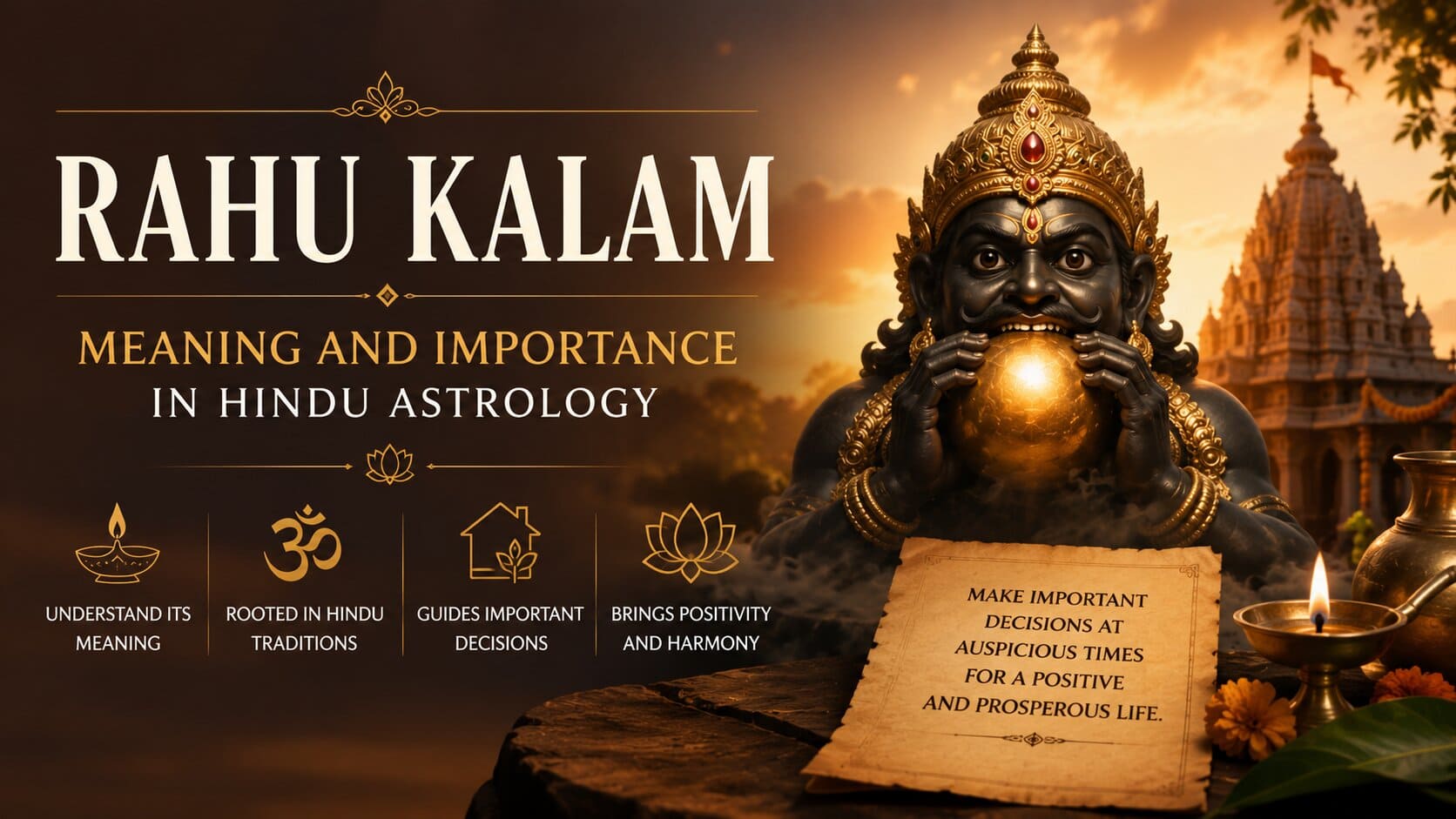
Rahu Kalam meaning and importance in Hindu astrology illustrated with a traditional Rahu deity statue and temple background.
In this Story

What Is Rahu Kalam?

Rahu Kalam in Hindu Astrology

Importance of Rahu Kalam in Daily Life

Rahu Kalam and Shubh Muhurat

Difference Between Rahu Kalam and Yamagandam

Common Misconceptions About Rahu Kalam

Conclusion

Frequently Asked Questions

Rahu Kalam is a common time that many observe within the Hindu traditions and Vedic astrology. Most people within India would avoid engaging in any vital activity or ventures during this specific period. It is generally believed to be an inauspicious time. Although this practice has been carried out for centuries, the importance is still carried onto modern times in determining auspicious timings for ceremonial events, journeys, monetary affairs, and other religious matters.


By grasping the essence of Rahu Kalam, an individual can begin to understand why this specific time block is so integral to the Hindu belief system. The same is also tied into concepts like Shubh Muhurat and Yamagandam, that are often kept in mind when determining a favorable time.


This guide aims to enlighten you on what Rahu Kalam essentially is, why it is important in Vedic astrology, how it's different from Yamagandam, and some frequent myths and beliefs associated with this.

What Is Rahu Kalam?

The period that falls within the day known as Rahu Kalam is thought to be inauspicious time for starting any significant activity, according to Hindu mythology. Initiating any activity within this time frame will cause delays or other hindrances according to Hindu mythology.

Unlike a fixed timing, Rahu Kalam changes everyday depending on the sunrise and sunset.


Rahu Kalam Meaning

The term “Rahu Kalam” is derived from two words of Sanskrit language; Rahu, meaning Rahu who is one of the nine celestial influences or Nava grahas of Hindu Astrology and “Kalam” meaning time/period.

Thus the basic meaning of Rahu Kalam can be considered as the time period ruled by Rahu. In this particular period, no good work such as marriage, business, buying new houses and investing money takes place.While normal work can continue, there is an advice not to start any major projects during this time period.


Origin and Significance in Hindu Traditions

The origins of Rahu Kalam can be traced back to the ancient beliefs of Hinduism and astrology. This idea developed along with the studies of planetary impacts on humans and time division based on heavenly bodies.

In accordance with the description of the Hindu calendar, calculations of time in Hindu traditions are tightly associated with astronomical phenomena and religious rituals. The Hindu calendar has been directing different events during many years, and thus timing was of utmost importance. Thus, Rahu Kalam was born as another time-oriented tradition.


Why It Is Considered Inauspicious

In general, Rahu is connected with illusion, confusion, uncertainty, and unexpected situations. Thus, Rahu Kalam is regarded as an inauspicious time to undertake something which will bring a good effect in the future.

It is often believed that doing anything during such a period can be connected with some problems or troubles. Nevertheless, praying, meditating, and other similar practices are permitted to be done during Rahu Kalam.

Rahu Kalam in Hindu Astrology

It's due to this reason Rahu Kalam is treated very important in Vedic Astrology. Also, Rahu is considered a 'shadow' planet among Navgrahas as compared to other planets which are visible. In the basic structure of Vedic Astrology, it has always been said that Rahu is considered as one of the dominant influential bodies which controls human life and life.


Role of Rahu in Vedic Astrology

In Vedic astrology, Rahu signifies ambitions, lust, worldly possessions, transformation, and an event that comes out of the blue. Although thought to be a bad influencer, Rahu can at some points prove to be highly favorable and bring about popularity and renown. Rahu when aspected in the horoscopes of the person results in some great innovation, invention, fame, or eccentric approach of living, but at the same time when not in balance, it also makes life quite chaotic and unreliable.


Considering the opposing natures of Rahu, it is one such influencer when astrological charts are consulted and good auspicious times are determined to be chosen. Traditional elements like Shaligram stone are not overlooked by homeowners and pious persons.


Astrological Importance of Rahu Kalam

Rahu Kala is significant for timing purposes. No matter how favorable a day may be as per the astrologers, you are strongly advised not to commence with important deeds during the said hours. The type of things astrologers do not suggest commencing are: 

● Marriage ceremonies

● Starting a new business

● Making investments

● Commencing an agreement

● Purchasing property

● Important travel 

● Taking on a commitment.

That said, those things that have already started will not be obstructed.


Cultural and Spiritual Relevance

In India today, Rahu Kalam is woven into the fabric of local traditions and culture. Even communities and families planning auspicious events take it into consideration. 

To a lot of people, timing their affairs according to the day's Rahu Kalam is a sign of honour for tradition and not due to any religious anxiety. Many families even perform various rites, sing devotional hymns, or engage in prayers during their scheduled time on this Rahu Kalam.

Importance of Rahu Kalam in Daily Life

Rahu Kalam’s impact isn’t limited to astronomy; it has also come to govern how many decide to go about scheduling significant events or decisions.

Even today, ancient timing rules and modern living continue to exist together.


Why People Consider Rahu Kalam

Many people mark and monitor Rahu Kalam for the good results from activities undertaken during that period of time, this is also part of cultural thinking and beliefs about living life in harmony with cosmic forces and nature for a blissful and prosperous life. 

Many use Panchang, or read up on Panchangas, or consult astrologers about planning the big date/occasion and many take decisions after looking at Vastu dos and don’ts and importance of Vastu for their home.


Activities Traditionally Avoided

Activities generally prohibited during Rahu Kalam:

● Starting a journey. 

● Purchasing a vehicle. 

● Property registration.

● Opening a business.

● Marriage ceremonies. 

● Signing an agreement/contract. 

● Starting an investment. 

The everyday work or the normal routine continues as usual.Some communities/regions are more rigorous about these customs than others.Some others consider it an optional instruction.


Modern-Day Relevance

Even today in India many people consult the Rahu Kalam before taking up anything important in personal as well as in their professional lives. They are commonly found with the mobile applications, website called panchang or with the digital diaries which display the timings daily. 

Younger generations might take the interpretations of the culture in a different way; still there is quite a good percentage of the population still following not taking any starts in life in the Rahu Kalam. No matter the westernisation or advancement, these traditions exist by the side.

Rahu Kalam and Shubh Muhurat

Rahu Kalam and Shubh Muhurat are related, as each of these methods help in choosing appropriate muhurat or time to perform certain events. Various factors are taken into consideration by people in search of Muhurat or auspicious time.


What Is Shubh Muhurat?

Shubh Muhurat is an astrologically predicted time that suggests prosperity, auspiciousness, accomplishment and auspicious results. It may perhaps be discovered from planetary locations in conjunction with the moon phase, lunar divisions (nakshatras) & time of week. 

The wedding functions, new dwelling launch work, naming, company debut, & some others, could be performed in this shubh time. The reliable Panchanag guides on shubh muhrat for various performances.


Relationship Between Rahu Kalam and Auspicious Timings

Rahu Kalam The presence of Rahu Kalam during a day often dissuades astrologers from fixing the wedding date during the Rahu Kalam on an auspicious day. 

To put it in other words, the day being favorable doesn’t mean that you should proceed for a new beginning at the inappropriate times. Several Panchang and Muhurta specialists consider a new start only after examining the Rahu Kalam of the day, which along with Vastu rules of house directions, determines the Shubh Muhurat for the housewarming and the settling in new abodes.


Major Events and Muhurat Considerations

Major life events commonly planned with Muhurat considerations include:

● Weddings.

● Housewarming ceremonies.

● Property purchases.

● Vehicle purchases.

● Business openings.

● Naming ceremonies.

● Religious functions.

Although these practices are based on tradition and belief, they continue to hold immense cultural significance for millions of people.

Difference Between Rahu Kalam and Yamagandam

Many are of the opinion that Rahu Kalam and Yamagandam are the same due to the notion that both time durations are considered to be unlucky. 

But, both concepts have their specific importance and usages. Knowing the differences would help understand the times specified on Panchang with much more clarity.


Understanding Yamagandam

In similar fashion, Yamagandam is also another inauspicious time recognized in Hindu practices. Like Rahu Kalam, the daily occurrence of Yamagandam is different each day because it is calculated according to sunrise and sunset times.

In conventional interpretation using Panchang, Yagamandam generally is avoided before starting on travels and major projects. Most daily calendars will show Rahu Kalam, Yamagandam, and Gulika Kalam together.


Key Differences

The following points contrast Rahu Kalam and Yamagandam;

● Rahu Kalam is governed by Rahu while Yamagandam has an association with Yama. 

● The actual timing differs from day to day. 

● It is not considered good to undertake new activities at this time. 

● This varies slightly in some regions from travel being specific for Yamagandam and vice versa.

Though they are considered evil hours for commencing any auspicious endeavor, the significance differs Astrology


Significance in Hindu Astrology

In Hindu astrology, these time periods serve as guidelines rather than rigid rules. Their significance lies in helping individuals choose favorable timings according to traditional beliefs.

Astrologers often analyze several factors simultaneously instead of relying solely on Rahu Kalam or Yamagandam.

Common Misconceptions About Rahu Kalam

Despite its popularity, several myths surround Rahu Kalam. Understanding the facts can help people develop a balanced perspective.


Popular Beliefs and Myths

There is another misconception people carry, they usually feel that during Rahu Kalam nothing should be done at all. This is completely false, people can perform their daily activities, work in the office, study or do household chores at this time as before.


Scientific Perspective

Scientifically, no proof is found anywhere to correlate RAHU Kalam with either success or failure. Astronomers are not listing RAHU as a planet, it is only a mathematical point that is associated with eclipses,so RAHU Kalam is basically a faith and culture,not a scientific fact. It should respect the traditions but still a rationalist has his own way of decision making.


Facts to Know

Some important facts about Rahu Kalam include:

● Its timing changes every day.

● It depends on the local sunrise and sunset.

● Routine activities are not restricted.

● Spiritual practices are considered acceptable.

● It holds cultural significance for millions of Hindus.

● Different regions may follow varying customs.

Understanding these facts helps separate myths from traditional practices.

Conclusion

Rahu kalam is another very prominent notion prevalent within Indian tradition and within astrology. Knowing the Rahu Kalam meaning offers us profound wisdom pertaining to the customs traditionally in practice amongst thousands and thousands in India. Rahu Kalam meaning in Indian astrology essentially goes with timing and being cautious, rather than fearing a day.


The connection of Rahu kalam with Shubh Muhurat shows how paramount these timed auspicious opportunities used to be thought of Even though no proof of Rahu kalam exists in science, it continues to hold its sway culturally as well as spiritually, where a belief in the culture dictates it, or a symbolism is extracted from the tradition.

Frequently Asked Questions

Q1. What is Rahu Kalam?

The timings of Rahu Kalam change on a daily basis, which depends on local sunrise and sunset timings. It’s typically found in any Panchang or Hindu calendar that can be readily used. A Rahu Kalam can cause delays or bad luck if one begins a new venture during this time. It has been said that there might be several bad occurrences when one undertakes a good work during the same day.


Q2. What activities should be avoided during Rahu Kalam?

Generally, in the duration of Rahu Kalam, it is considered unfavorable to initiate new and important tasks like wedding, purchase of a new house, starting a business or office, signing a deal or investing in money, start of journey. Routine works of the house, office or studying, and eating habits are generally done during Rahu Kalam, the only caution is for new ventures.


Q3. Is Rahu Kalam the same every day?

No, Rahu Kalam does not remain constant; it vary in different days as the timing of sunrise and sunset vary each day according to location in the daily calendar or panchang. Usually it is around 90 minutes long and varies to different hours as per day.


Q4. Can we perform prayers or spiritual activities during Rahu Kalam?

Yes, in spiritual terms, chanting prayers, meditation and offering devotional songs or hymns is absolutely allowed in Rahu Kaal. This constraint is just for the beginning of new tasks or new projects of any significance. Some people, in fact, choose this time to worship their deities.


Q5. What is the difference between Rahu Kalam and Yamagandam?

Rahu Kalam and Yamagandam are inauspicious timing according to Hinduism but they have different planetary involvement. Raahu Kalam comes under control of planet Rahu while Yamagandam comes under the command of the God Yama. They are different from each other, both vary from day to day. We can find both of them in a Panchang and we do not perform auspicious deeds in their timing.

Blogs

Clicky
homefleet logo

About Us

Property Areas

Tellapur
Narsingi
Mokila
Kollur

Resources

Legal
Remote Support

Terms of use | Privacy

Copyright by 2023 @ Home Fleet
Developed by:
Tvisha