
homefleet-callhomefleet-whatsapp

What Is a Shaligram Stone? Meaning, Importance, and Benefits Explained
Author Name Dimpi
May 29, 2026
What Is a Shaligram Stone? Meaning, Importance, and Benefits Explained

What Is a Shaligram? 

This Is the One Thing People Are Getting Wrong About the Stone

Step into almost any Hindu household in India or Nepal, and at one corner where the worship place is situated, most often near a Tulsi plant along with maybe some water, you'll see a small, black, and peculiarly round stone. Not much else about it catches the eye. That's the idea behind it.

This is a Shaligram. And if this is the first time that you have come across this name, don't worry because you certainly aren't the only one to be unaware about this religious practice.


But what exactly is it?

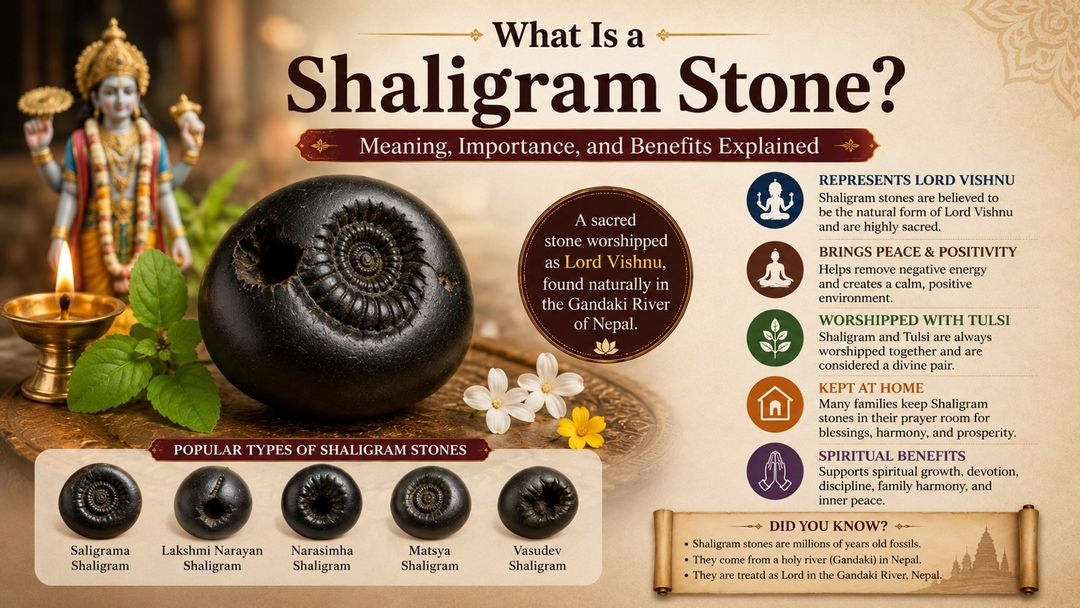
Well, it's important to know that the Shaligrams aren't sculpted by anyone. They are not made artificially. Instead, they are formed naturally through millions of years of development and erosion at the bottom of the Gandaki River in Nepal. In geological terms, Shaligrams are fossilized remains of ammonites, a prehistoric oceanic species long extinct. But the process of formation doesn't end there. The river itself shapes and polishes the stones, adding unique spirals along the surface.

This natural formation is crucial to understand the meaning of a Shaligram. In Hindu mythology, Lord Vishnu – who is responsible for keeping order in the world – is believed to reside within the Shaligram not symbolically but literally. In other words, the stone is believed to represent the real God himself. It's not an imitation of Vishnu; instead, it is Vishnu. That's why no one carves Shaligrams or creates them manually.

Every Shaligram is unique in appearance, with some having circular marks known as chakras, others having hollows or deep spiral marks on their surface. According to believers, each of these marks indicates what particular manifestation of Vishnu each stone represents.


Why The Gandaki River In Particular?

It’s one of those little pieces of information people often forget about, but it’s important. The Gandaki River, also known as Kali Gandaki, is located in a particular part of Nepal where there is a very high density of ammonite fossils. In fact, there are so many that you’ll find them at the bottom of the river.

For this reason, true Shaligrams will only come from this river. Any other claim should be doubted.

Tulsi and the Shaligram Connection

Rarely will you find a Shaligram that stands alone. It will most likely have a Tulsi plant right beside it, and there is a reason for this.

This is because there is a legend in Hindu mythology about how Goddess Tulsi had a divine connection with Lord Vishnu. Even without going deeply into the mythology itself, one can say that this connection is held with high regard in terms of spirituality, and this makes worshiping both together complete, unlike worshiping only one of them.

In many homes, it is considered the spiritual focal point, with the plant, the stone, and the tiny flame from a diya.

Variety of Types – Why It Is Important

Not all Shaligrams are equal and their identification is regarded as important. Some common examples include:

Sudarshan Shaligram that features a chakra design that is attributed to Vishnu’s protection. Lakshmi Narayan Shaligram which symbolizes prosperity and peace within the family. Narasimha which represents Vishnu’s fierce and protective nature. Matsya which is one of the rare Shaligram stones and signifies wisdom and guidance.

As you can see, there are some aspects here that may be open for interpretation, particularly when different families use various traditions to define their meaning. In other words, what one family would consider as a Lakshmi Narayan Shaligram stone might be identified differently by someone else based on the symbols.

How Does Keeping It Home Impact You?

That's when it becomes personal, since the truth of the matter is that it just depends on whom you ask.

Families who follow the tradition of worshipping Shaligrams frequently describe their experience with the act of praying, just as much as they describe the object itself. Cleaning it every morning, offering it Tulsi leaves, making an offering of light, meditating for some time that cycle makes a huge impact on its followers. They get into a routine which helps them stay grounded.

For some, it makes a change in the atmosphere at home. They feel as if there is something different about it – they are calmer, more composed. Whatever the reason behind that feeling might be, whether it is attributed to the Shaligram stone itself or to the calming effects of the process in general, it achieves something positive. Calmer mind. Patience.


Is It Acceptable to Keep It Without Being a Priest?

Yes. This is a more common than you might think question. The answer to it is simply yes.

The stones have been preserved by average families in their home prayer rooms for many generations – not only in temples and not exclusively by priests. All that is important according to traditional teachings about this practice is treating the stone and the place where it resides with appropriate reverence. Cleanliness is paramount here, but the stone is also never supposed to be left on the floor and should be handled with respect and care.

The ceremony itself may be made up of simple rituals that do not involve any specific procedures or actions.


How Do You Recognize a Fake?

This is quite an essential question since there are fakes available on the market nowadays.

For one thing, it should be noted that the stone needs to feature organic patterns that cannot be artificially replicated due to their individuality. The spirals/chakras present on it should never be symmetrical and look like something you could easily create on your own. Moreover, the stone needs to be truly river-polished. In other words, its surface will be black or very dark brown. And it will not appear as something manufactured in a factory.

When purchasing a canoe, avoid those that appear to have been produced in a factory. Purchase a canoe from someone who can explain its origin and the particular river segment it originated from.


Why Do People Remain This Invested in Such Stones in 2026?

A very valid question indeed.

In an era where speed is paramount, where distraction reigns supreme, and silence is becoming a rarity, there appears to be a growing trend among not only those of devout faith but also many others towards tangible practices. Something tangible. Something you touch. Something you repeat daily. Something without alerts.

This is what the Shaligram represents, the convergence of the archaic and the intimate. It has existed in homes for centuries. It holds the power of this tradition. And for some, this power is not oppressive but reassuring.

Some Facts That Are Important

First, Shaligrams are real fossils that have been in existence for several million years ago. Second, no two Shaligrams look the same since they all have unique appearances and formations. Third, the act of venerating both Shaligrams and Tulsi together is deemed to be incomplete when one or both are absent. Fourth, certain rare Shaligrams, which possess unique formations and/or have more than one chakra marking, are deemed extremely valuable.

Common Misconceptions

First, and most importantly, is the idea that some sort of ceremony or special knowledge, even priesthood, is required for possession and reverence of a Shaligram. It isn’t. Secondly, the common assumption is that anything round or black stone is a Shaligram; in reality, nothing of the sort will work without the natural markings. Finally, people assume that it’s just another form of superstition. True or not, there’s definitely a basis in truth behind this belief, which goes back to an intrinsic part of human nature that uses objects and rituals in order to ground oneself.

Conclusion

The Shaligram is a fossil found in a river in the Himalayas that is worshipped as a living god by millions of people. What an odd and amazing phenomenon to think about.

If you're part of the culture, nothing could be more normal than this fossil being Vishnu incarnate through natural means. If you're from outside this culture, the Shaligram is an interesting case of how the sciences of geology, mythology, and human interaction can fuse together in time.

Either way, it's something to keep in mind.

FAQs

1. What is a Shaligram stone?

A Shaligram is a sacred black fossil stone found mainly in the Gandaki River of Nepal. In Hinduism, it is worshipped as a natural representation of Lord Vishnu.

2. Why is the Shaligram considered sacred?

The Shaligram is believed to contain the divine presence of Lord Vishnu. Unlike idols made by humans, Shaligrams are naturally formed, which makes them spiritually significant in Hindu tradition.

3. Can anyone keep a Shaligram at home?

Yes. Ordinary families commonly keep Shaligrams in their home temples. Traditional beliefs mainly emphasize cleanliness, respect, and proper care rather than priesthood or special rituals.

4. What are the benefits of keeping a Shaligram at home?

Many devotees believe a Shaligram brings peace, positivity, spiritual energy, patience, and harmony into the home. Daily worship practices may also help create mental calmness and discipline.

5. Why is Tulsi worshipped with the Shaligram?

According to Hindu mythology, Tulsi has a divine connection with Lord Vishnu. Worshipping Tulsi together with the Shaligram is considered spiritually complete and highly auspicious.

6. How can you identify a real Shaligram stone?

A genuine Shaligram usually has natural spiral or chakra-like markings formed through fossilization and river erosion. Real Shaligrams come only from the Kali Gandaki River region in Nepal.

7. Are all Shaligrams the same?

No. Different Shaligrams have different markings, shapes, and symbolic meanings. Some represent forms of Vishnu such as Narasimha, Lakshmi Narayan, Matsya, or Sudarshan.

8. Is a Shaligram scientifically a fossil?

Yes. Scientifically, Shaligrams are fossilized ammonites extinct marine creatures that lived millions of years ago. Their religious importance comes from Hindu spiritual beliefs connected to these natural fossils.
What Is a Shaligram Stone? Meaning, Importance, and Benefits Explained

Published by : Dimpi
May 29, 2026
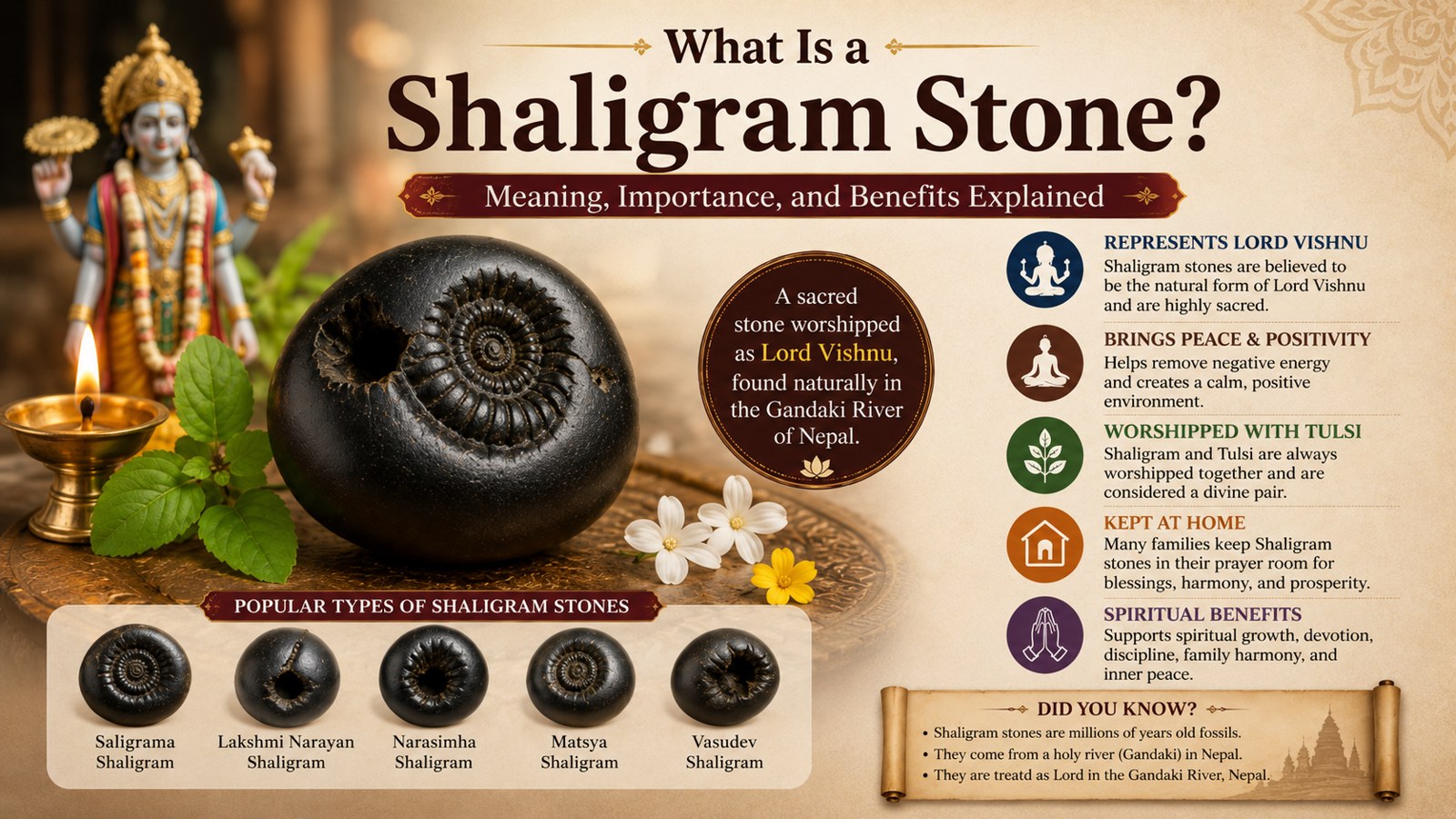
Infographic of a black Shaligram Stone with Lord Vishnu idol, explaining its meaning, spiritual importance, benefits, and different types in
In this Story

Tulsi and the Shaligram Connection

Variety of Types – Why It Is Important

How Does Keeping It Home Impact You?

Some Facts That Are Important

Common Misconceptions

Conclusion

FAQs

What Is a Shaligram? 

This Is the One Thing People Are Getting Wrong About the Stone

Step into almost any Hindu household in India or Nepal, and at one corner where the worship place is situated, most often near a Tulsi plant along with maybe some water, you'll see a small, black, and peculiarly round stone. Not much else about it catches the eye. That's the idea behind it.

This is a Shaligram. And if this is the first time that you have come across this name, don't worry because you certainly aren't the only one to be unaware about this religious practice.


But what exactly is it?

Well, it's important to know that the Shaligrams aren't sculpted by anyone. They are not made artificially. Instead, they are formed naturally through millions of years of development and erosion at the bottom of the Gandaki River in Nepal. In geological terms, Shaligrams are fossilized remains of ammonites, a prehistoric oceanic species long extinct. But the process of formation doesn't end there. The river itself shapes and polishes the stones, adding unique spirals along the surface.

This natural formation is crucial to understand the meaning of a Shaligram. In Hindu mythology, Lord Vishnu – who is responsible for keeping order in the world – is believed to reside within the Shaligram not symbolically but literally. In other words, the stone is believed to represent the real God himself. It's not an imitation of Vishnu; instead, it is Vishnu. That's why no one carves Shaligrams or creates them manually.

Every Shaligram is unique in appearance, with some having circular marks known as chakras, others having hollows or deep spiral marks on their surface. According to believers, each of these marks indicates what particular manifestation of Vishnu each stone represents.


Why The Gandaki River In Particular?

It’s one of those little pieces of information people often forget about, but it’s important. The Gandaki River, also known as Kali Gandaki, is located in a particular part of Nepal where there is a very high density of ammonite fossils. In fact, there are so many that you’ll find them at the bottom of the river.

For this reason, true Shaligrams will only come from this river. Any other claim should be doubted.

Tulsi and the Shaligram Connection

Rarely will you find a Shaligram that stands alone. It will most likely have a Tulsi plant right beside it, and there is a reason for this.

This is because there is a legend in Hindu mythology about how Goddess Tulsi had a divine connection with Lord Vishnu. Even without going deeply into the mythology itself, one can say that this connection is held with high regard in terms of spirituality, and this makes worshiping both together complete, unlike worshiping only one of them.

In many homes, it is considered the spiritual focal point, with the plant, the stone, and the tiny flame from a diya.

Variety of Types – Why It Is Important

Not all Shaligrams are equal and their identification is regarded as important. Some common examples include:

Sudarshan Shaligram that features a chakra design that is attributed to Vishnu’s protection. Lakshmi Narayan Shaligram which symbolizes prosperity and peace within the family. Narasimha which represents Vishnu’s fierce and protective nature. Matsya which is one of the rare Shaligram stones and signifies wisdom and guidance.

As you can see, there are some aspects here that may be open for interpretation, particularly when different families use various traditions to define their meaning. In other words, what one family would consider as a Lakshmi Narayan Shaligram stone might be identified differently by someone else based on the symbols.

How Does Keeping It Home Impact You?

That's when it becomes personal, since the truth of the matter is that it just depends on whom you ask.

Families who follow the tradition of worshipping Shaligrams frequently describe their experience with the act of praying, just as much as they describe the object itself. Cleaning it every morning, offering it Tulsi leaves, making an offering of light, meditating for some time that cycle makes a huge impact on its followers. They get into a routine which helps them stay grounded.

For some, it makes a change in the atmosphere at home. They feel as if there is something different about it – they are calmer, more composed. Whatever the reason behind that feeling might be, whether it is attributed to the Shaligram stone itself or to the calming effects of the process in general, it achieves something positive. Calmer mind. Patience.


Is It Acceptable to Keep It Without Being a Priest?

Yes. This is a more common than you might think question. The answer to it is simply yes.

The stones have been preserved by average families in their home prayer rooms for many generations – not only in temples and not exclusively by priests. All that is important according to traditional teachings about this practice is treating the stone and the place where it resides with appropriate reverence. Cleanliness is paramount here, but the stone is also never supposed to be left on the floor and should be handled with respect and care.

The ceremony itself may be made up of simple rituals that do not involve any specific procedures or actions.


How Do You Recognize a Fake?

This is quite an essential question since there are fakes available on the market nowadays.

For one thing, it should be noted that the stone needs to feature organic patterns that cannot be artificially replicated due to their individuality. The spirals/chakras present on it should never be symmetrical and look like something you could easily create on your own. Moreover, the stone needs to be truly river-polished. In other words, its surface will be black or very dark brown. And it will not appear as something manufactured in a factory.

When purchasing a canoe, avoid those that appear to have been produced in a factory. Purchase a canoe from someone who can explain its origin and the particular river segment it originated from.


Why Do People Remain This Invested in Such Stones in 2026?

A very valid question indeed.

In an era where speed is paramount, where distraction reigns supreme, and silence is becoming a rarity, there appears to be a growing trend among not only those of devout faith but also many others towards tangible practices. Something tangible. Something you touch. Something you repeat daily. Something without alerts.

This is what the Shaligram represents, the convergence of the archaic and the intimate. It has existed in homes for centuries. It holds the power of this tradition. And for some, this power is not oppressive but reassuring.

Some Facts That Are Important

First, Shaligrams are real fossils that have been in existence for several million years ago. Second, no two Shaligrams look the same since they all have unique appearances and formations. Third, the act of venerating both Shaligrams and Tulsi together is deemed to be incomplete when one or both are absent. Fourth, certain rare Shaligrams, which possess unique formations and/or have more than one chakra marking, are deemed extremely valuable.

Common Misconceptions

First, and most importantly, is the idea that some sort of ceremony or special knowledge, even priesthood, is required for possession and reverence of a Shaligram. It isn’t. Secondly, the common assumption is that anything round or black stone is a Shaligram; in reality, nothing of the sort will work without the natural markings. Finally, people assume that it’s just another form of superstition. True or not, there’s definitely a basis in truth behind this belief, which goes back to an intrinsic part of human nature that uses objects and rituals in order to ground oneself.

Conclusion

The Shaligram is a fossil found in a river in the Himalayas that is worshipped as a living god by millions of people. What an odd and amazing phenomenon to think about.

If you're part of the culture, nothing could be more normal than this fossil being Vishnu incarnate through natural means. If you're from outside this culture, the Shaligram is an interesting case of how the sciences of geology, mythology, and human interaction can fuse together in time.

Either way, it's something to keep in mind.

FAQs

1. What is a Shaligram stone?

A Shaligram is a sacred black fossil stone found mainly in the Gandaki River of Nepal. In Hinduism, it is worshipped as a natural representation of Lord Vishnu.

2. Why is the Shaligram considered sacred?

The Shaligram is believed to contain the divine presence of Lord Vishnu. Unlike idols made by humans, Shaligrams are naturally formed, which makes them spiritually significant in Hindu tradition.

3. Can anyone keep a Shaligram at home?

Yes. Ordinary families commonly keep Shaligrams in their home temples. Traditional beliefs mainly emphasize cleanliness, respect, and proper care rather than priesthood or special rituals.

4. What are the benefits of keeping a Shaligram at home?

Many devotees believe a Shaligram brings peace, positivity, spiritual energy, patience, and harmony into the home. Daily worship practices may also help create mental calmness and discipline.

5. Why is Tulsi worshipped with the Shaligram?

According to Hindu mythology, Tulsi has a divine connection with Lord Vishnu. Worshipping Tulsi together with the Shaligram is considered spiritually complete and highly auspicious.

6. How can you identify a real Shaligram stone?

A genuine Shaligram usually has natural spiral or chakra-like markings formed through fossilization and river erosion. Real Shaligrams come only from the Kali Gandaki River region in Nepal.

7. Are all Shaligrams the same?

No. Different Shaligrams have different markings, shapes, and symbolic meanings. Some represent forms of Vishnu such as Narasimha, Lakshmi Narayan, Matsya, or Sudarshan.

8. Is a Shaligram scientifically a fossil?

Yes. Scientifically, Shaligrams are fossilized ammonites extinct marine creatures that lived millions of years ago. Their religious importance comes from Hindu spiritual beliefs connected to these natural fossils.

Blogs

Clicky
homefleet logo

About Us

Property Areas

Tellapur
Narsingi
Mokila
Kollur

Resources

Legal
Remote Support

Terms of use | Privacy

Copyright by 2023 @ Home Fleet
Developed by:
Tvisha